Local cities
Los Angeles
About this guide and how we research candidates
Volunteers research every contested race and measure directly: public filings, voting records, community group positions, and direct outreach to campaigns. We rate every entry, including when we land on No Recommendation, and we publish our reasoning for all of it.
Candidates and ballot measure committees were not given the opportunity to pay for preferential treatment and were not shown these recommendations before they were published.
Tap a name to read why.
Citywide offices
Mayor: Nithya RamanEndorsed
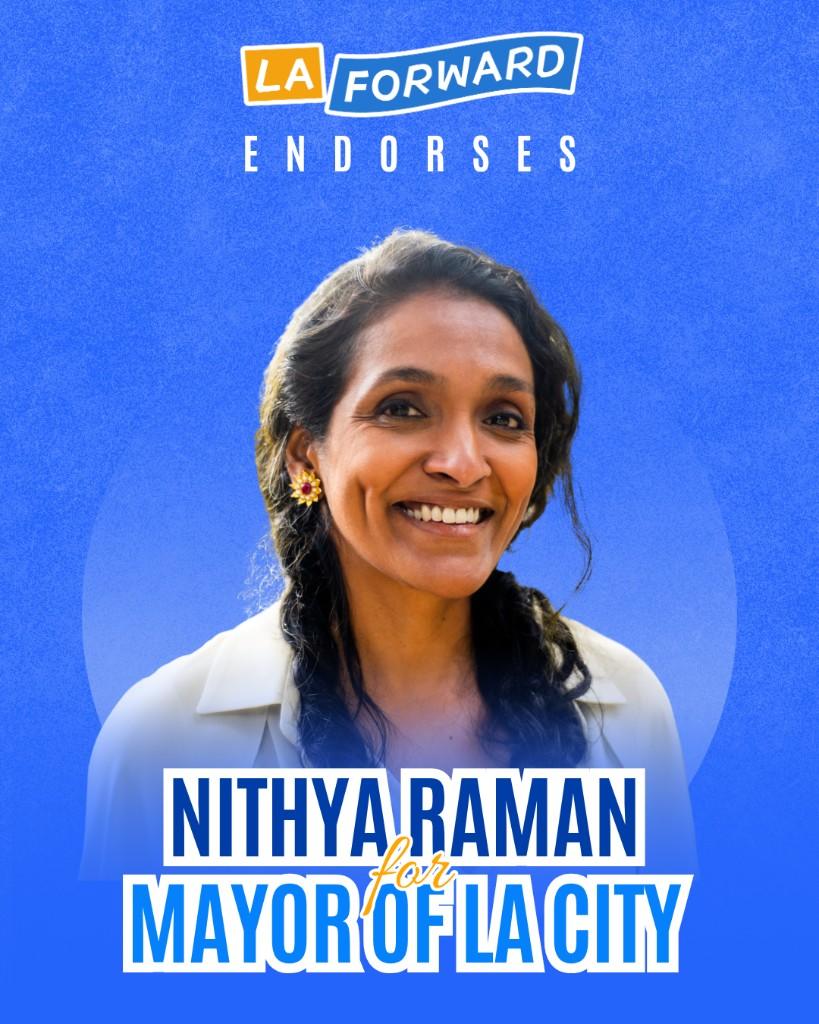
LA Forward members determine who we endorse in every race and their choice in this race was decisive. More than 90% of our members voted to endorse Nithya Raman as the best option for Mayor.
Being LA’s Mayor is an incredibly difficult job in the best of times. And needless to say, these are not the best of times. As former Deputy Mayor and Deputy Controller Rick Cole has noted, “beneath the broken sidewalks is a broken system that desperately needs fixing.”
Of the two candidates in this race, we believe Councilmember Raman is best suited to ensure LA City government truly delivers for all Angelenos.
Mayor Bass is smart, hard-working, and rooted in a long history of organizing and public service. That’s why we were proud to endorse her in 2022. But with notable exceptions such as verbally standing up to ICE, she hasn’t risen to the challenge of being Mayor, especially when it comes to managing our city government and communicating effectively with the public. Bass has frequently taken the political path of least resistance, taking for granted the progressive voter base that got her elected initially. Bass has prioritized appeasing powerful interests like the police union and Airbnb, which are the same forces that have funded conservative candidates across the city, and are now spending millions of dollars to boost her re-election campaign.
Despite Raman’s much shorter tenure in local politics, she has a clearer understanding of the ineffective areas of our city government, and a vision for how to fix them.
Raman’s track record in office over the last six years has largely aligned with LA Forward’s priorities
* Nithya helped move LA toward a citywide unarmed crisis response system
* Nithya spearheaded new protections for renters (even before new progressive colleagues joined her on council in 2022),
* Nithya co-authored the sanctuary city ordinance to protect immigrants
* Nithya championed good governance reforms to reduce corruption and increase the effectiveness of government
* Nithya secured a unanimous council vote for building electrification climate policy, and backed expanded transportation and mobility options
There is a clear contrast between the two candidates over the last four years
* Nithya used her position as chair of the Council’s Housing and Homelessness Committee to try to get the Venice Dell affordable housing project out of the red tape purgatory to which Mayor Bass, City Attorney Hydee Feldstein Soto, and Councilmember Traci Park had consigned it.
* Nithya was one of only a few votes against deals created by Mayor Bass that drained the city’s coffers through overspending on police salaries and a Convention Center overhaul, leading to cutbacks of other vital city services.
* Nithya fought for real charter reform, including council expansion, greater oversight powers for the City Controller, and increased police accountability, while Mayor Bass unnecessarily delayed the Charter Commission’s start by eight months and then thwarted attempts at broader reform.
* Nithya used her role on the AQMD board to fight climate change and air pollution before Mayor Bass removed her for being too hard-charging.
Aside from all the issues where we’ve appreciated Raman’s leadership more than Bass’s, we are most hopeful about things that are not policy-specific.
Recently Bass supporters have been spreading the idea that LA City’s mayor is “weak” and that the Council has all the real power. While the Council wields tremendous power, the Mayor has extensive authority to make change within city government, as long-time nonpartisan observers have noted in recent pieces by Robert Greene and Jim Newton.
We need a Mayor who pays attention to management, hires top leaders who understand how to get things done at City Hall, and communicates in a way that meets the challenges of the always-on media landscape.
We need a Mayor who is laser-focused on ensuring LA City government works well on a daily basis, holds Department leaders accountable for outcomes, and keeps policy implementation and Angelenos’ experience of government top of mind.
This is not an easy task for anyone but Bass has been largely missing in action and we see Raman asking the right questions and setting the right priorities.
We’re also impressed by Raman’s ambitious and detailed policy agenda. We’re reassured by the commitments she’s made to us personally for collaborative governance and coalition-building, including on issues where we don’t agree.
While we appreciate Bass’ focus on homelessness, we agree with Raman’s assessments about the flaws of “Inside Safe” which is getting more expensive and less effective. And while we appreciate some of the achievements that have occurred during Bass’ tenure in office, like getting LA off of coal power, in most cases, Bass is taking credit for policies that others spearheaded long before she was Mayor. Bass was not the first mayor to notice and address homelessness despite what she has claimed. Eric Garcetti, for all his own flaws, spent real political capital to campaign for more funding for homeless housing with Measure HHH in 2016 and work to get bridge/interim housing built across the city.
Bass’ appointment of Jim McDonnell as police chief has been a huge step backwards for the city, a stance so dismaying that it caused the Black LA Young Democrats to support Raman.
Raman has received an impressive array of endorsements including City Controller Kenneth Mejia, former Controller Laura Chick, the California Working Families Party, Eastside Padres, Latino Coalition of Los Angeles, ACCE, Initiate Justice Action, nearly all environmental environmental organizations – Sierra Club, LA League of Conservation Voters, Sunrise Movement, Food & Water Action, Climate Action California, California Environmental Voters –, a growing number of Democratic clubs, plus unions of healthcare workers (SEIU 121RN Nurse Alliance, Committee of Interns and Residents/SEIU), transportation workers (Transportation Communications Union/IAM, Transport Workers Union of America), hospitality workers (UNITE HERE 11), LA City professional workers (EAA Union) Writers Guild of America West, Carpenters, Inlandboatmen’s Union of Pacific (ILWU), AFT Local 1521A, and UAW Region 6.
For all these reasons and more, LA Forward is proud to join partners in endorsing Nithya Raman for Mayor.
City Attorney: Marissa RoyEndorsed
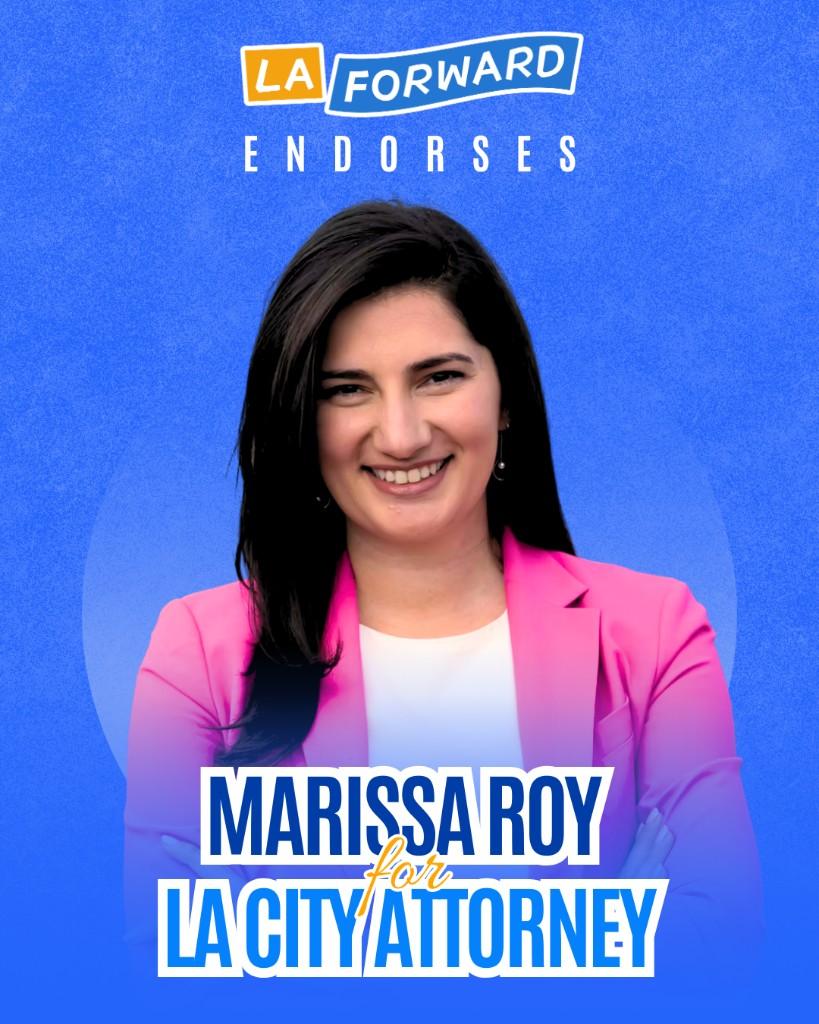
In the race for LA City Attorney, voters have one of the easiest choices on the ballot. Marissa Roy is the best choice for LA City Attorney. After a disastrous four years of incumbent Hydee Feldstein Soto, Roy promises to make the office of City Attorney a true public interest law firm that protects workers, tenants, immigrants, and communities from corporate abuse — not a rubber stamp for the powerful. We endorse Marissa Roy for LA City Attorney.
The City Attorney is LA’s lawyer: they advise the mayor and City Council, prosecute misdemeanors, and decide how aggressively the city takes on wage theft, illegal evictions, consumer fraud, and environmental harms. In practice, that means the City Attorney can either use the law to hold slumlords, union‑busting employers, polluters, and abusive police accountable – or duck those fights and leave communities on their own.
Recent years have shown how much damage a cautious, corporate‑friendly City Attorney can do, from weak enforcement against bad landlords to settlements that protect city departments more than residents. A progressive, movement‑aligned City Attorney can instead shift the office toward impact litigation, civil rights enforcement, and real accountability for abuses that fuel homelessness, displacement, and distrust.
Marissa Roy is a lifelong Angeleno who decided to go into public service when Proposition 8 stripped marriage equality from LGBTQ Californians, including her younger brother. She began her legal career in the LA City Attorney’s Office, bringing major workers’ rights cases to protect people from wage theft and other exploitation. Roy later served as outside counsel for Los Angeles County, where she joined legal actions against the Trump administration to defend sanctuary policies, DACA recipients, students, and immigrants seeking asylum. Today she is a Deputy Attorney General in the California Department of Justice, suing large tech companies over practices that threaten public health and safety and standing up for tenants who are wrongfully evicted and consumers who are defrauded.
Roy is explicit: she is running to transform the City Attorney’s Office into the largest public interest law firm in Los Angeles. Her agenda includes:
* Protecting workers and tenants by aggressively enforcing wage and hour laws, cracking down on wage theft, and defending renters from illegal evictions and abusive landlord practices.
* Taking on corporate and tech abuse by scaling up impact litigation against corporations engaged in unlawful, unfair, or deceptive conduct that harms Angelenos.
* Making civil rights and immigrants’ rights central to the office’s mandate, including pushing back on racial profiling, unconstitutional policing, and ongoing attacks from the Trump administration.
* Pursuing smart public safety by prioritizing strategies that actually make communities safer — diversion, prevention, accountability — rather than reflexive criminalization that feeds mass incarceration.
Roy’s entire career has been about using the law as a tool for economic and social justice, not as a shield for powerful institutions.
The incumbent, Hydee Feldstein Soto, came in third during the primary so Roy will be up against John McKinney, the second-place finisher.
McKinney, a deputy district attorney, comes from a traditional “tough on crime” background and has run on a more carceral, prosecutor‑first approach that would exacerbate the very problems progressives are trying to solve. He’s been backed by the Republican Party, the LAPPL police union, Republican DA Nathan Hochman, and a whopping $3 million of outside spending from Airbnb during the primary alone.
John McKinney’s right-wing ties are deeply disturbing. His campaign is backed by some of the biggest Republican and MAGA donors in California. And his campaign is being run by Republican consultants who have come under scrutiny for unethical conduct while working for Trump, including a controversial fundraiser accused of shady practices like money laundering.
Roy stands alone as the candidate who is both rooted in Los Angeles and clearly committed to turning the office loose on wage thieves, slumlords, polluters, and abusive corporations – and to reorienting the City Attorney’s work around workers, tenants, and over‑policed communities instead of City Hall insiders.
City Council
District 3: Barri Worth GirvanEndorsed
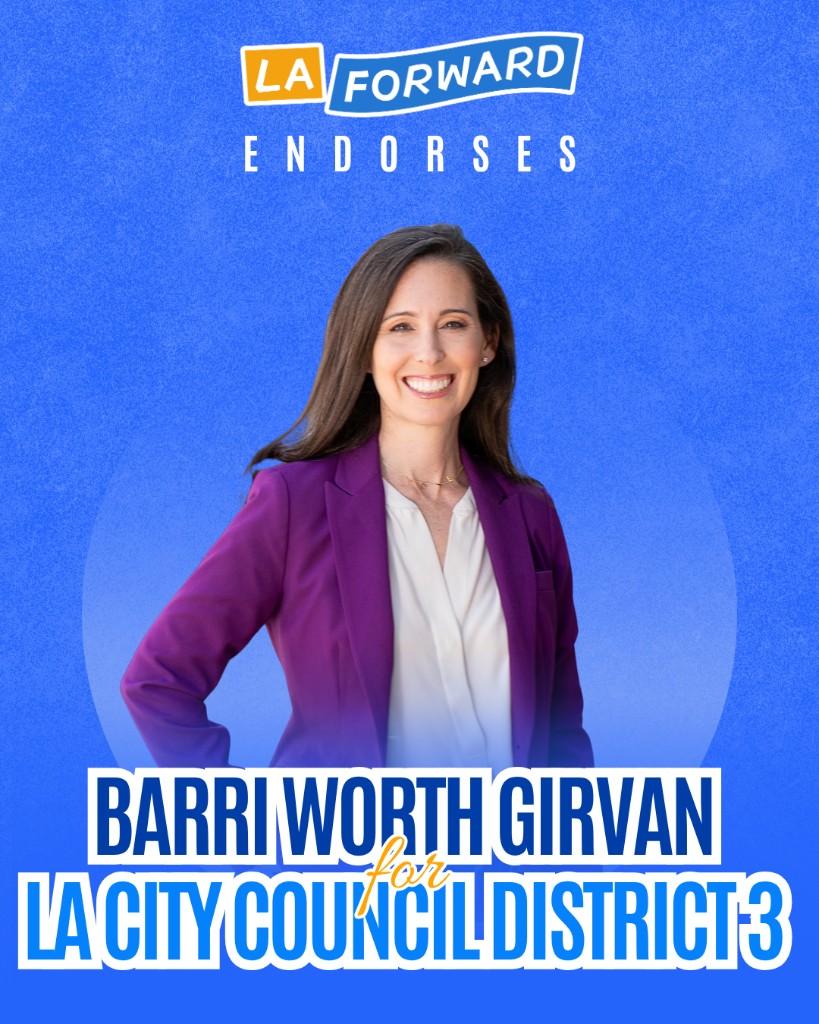
Councilmember Bob Blumenfield is termed out and so the southwest corner of the Valley has the first open race in more than a dozen years.
Barri Worth Girvan is the best choice for the West Valley, and LA Forward is proud to endorse her for LA City Council District 3.
She backs policies to tackle the housing crisis directly and supports a compassionate approach to homelessness that effectively gets people off the streets and into housing, instead of relying on criminalization.
She’s eager to promote the expansion of unarmed crisis response services across the Valley, so we’re not sending armed people to deal with issues that deserve trained mental health responders.
She’ll champion climate solutions that combat global warming which is driving up temperatures in the Valley year after year. And, she will back long-term, comprehensive infrastructure planning to help fix the broken sidewalks, streetlights, and potholes across our city.
Barri has had a long career in public service and a great reputation among people who know her. Her supporters include environmental organizations, including the LA League of Conservation Voters (LALCV) and Sierra Club, the Democratic Party of San Fernando Valley (DPSFV), the San Fernando Valley Young Democrats (SFVYD), the National Union of Healthcare Workers (NUHW), the Engineers & Architects Association (EAA), Women's Political Committee of Los Angeles (WPC) and California Women's List.
She also has endorsements from a wide range of Valley political and community leaders:
* Congresswomen Julia Brownley, Luz Rivas, and Sydney Kamlager-Dove;
* State Senators Henry Stern, Caroline Menjivar, Ben Allen, Maria Elena Durazo;
* State Assemblymembers Mark González, Nick Schultz, Jesse Gabriel, Celeste Rodriguez, Mike Fong, Pilar Schiavo
* Andra Hoffman, Los Angeles Community College Board of Trustees
* Nick Melvoin, LAUSD Board Member
* Nikki Perez, Mayor, City of Burbank
* Ray Pearl, Westlake Village Mayor and Councilmember
* Jeremy Wolf, Mayor Pro Tempore, City of Agoura Hills
* Alicia Weintraub, Calabasas City Councilmember and former Mayor
* David Shapiro, Councilmember and Former Mayor, City of Calabasas
* Danny Hang, West Hollywood Councilmember
* Ed Albrecht, Councilmember, City of Calabasas
* Deborah Klein Lopez, Agoura Hills Councilmember
In contrast, her opponent is backed by the police union, landlord lobby, real estate interests, and the most conservative members of the City Council.
Barri is not a movement progressive like most of our endorsed candidates, but we trust that she will work with us closely and partner to help make Los Angeles a fair, flourishing place for everyone, unlike her opponent who would consolidate a growing conservative presence on council.
For all these reasons and more, LA Forward endorses Barri Worth Girvan and encourages West Valley residents to vote for her!
District 9: Estuardo MazariegosEndorsed
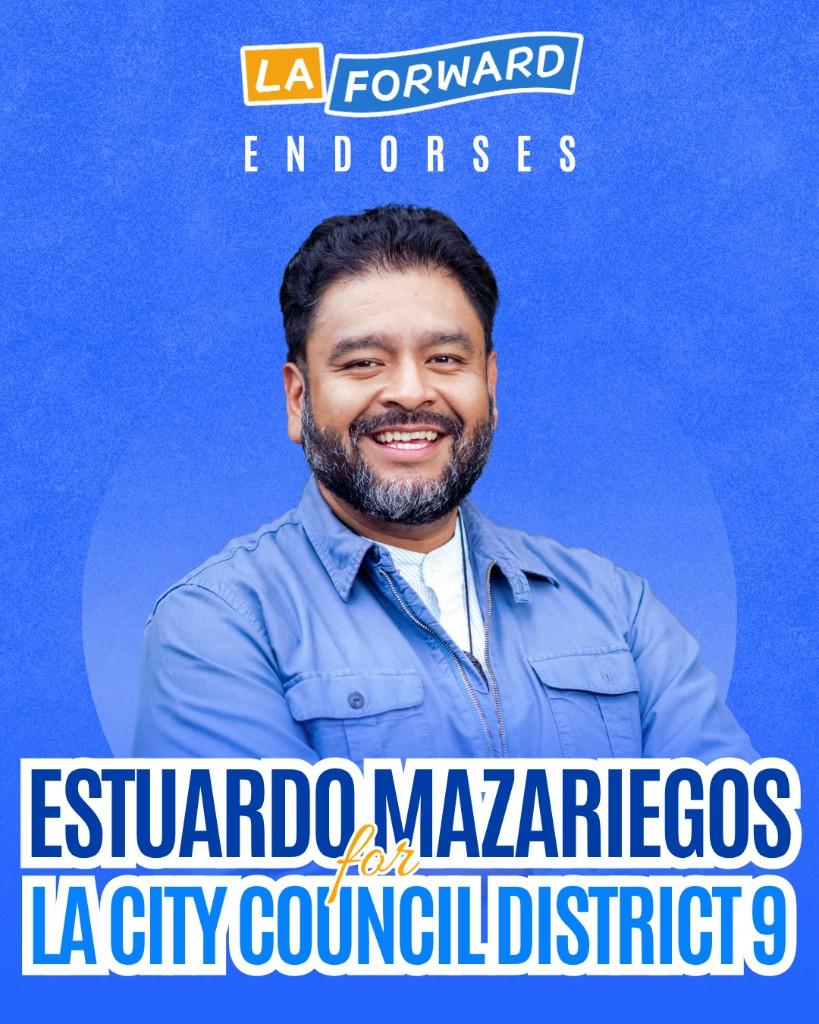
Estuardo Mazariegos is the best choice in City Council District 9, endorsed local teachers (UTLA), healthcare workers, environmental justice groups, and Bernie Sanders, and and all of us at LA Forward
Estuardo will be an unapologetic champion for working families, young people, immigrants, renters, and neighborhoods that City Hall has neglected for far too long.
He’s the only candidate with real plans to:
* Address homelessness effectively and compassionately, getting people off the streets and into housing with supportive services
* Fix streets, sidewalks, and streetlights
* Improve police accountability and address the causes of crime
* Protect and support the immigrant community
Council District 9 is one of the youngest, poorest, and most heavily burdened districts in Los Angeles, stretching from the southern edge of Downtown through South Los Angeles communities that face housing insecurity, disinvestment, and environmental harms. With Curren Price termed out, this is the first open-seat race in the district since 2013. It’s a real chance to send someone to City Hall who is rooted in community, instead of the insider culture that has repeatedly failed South L.A.
This is also a contest over what representation should look like in a district where residents are too often over-policed, under-served, and only remembered during election season. District 9 does not need another manager of decline or another politician promising ribbon cuttings while basic services fall apart; it needs a fighter.
Estuardo Mazariegos is a father, immigrant, and longtime community organizer who has spent nearly two decades working alongside low-income residents, tenants, immigrants, and Black and Brown families. He is the co-director of ACCE Los Angeles, a grassroots organization that has been central to major fights for renter protections, economic justice, and racial justice across the city.
Mazariegos’ story matters here because it is inseparable from the district he wants to represent. He came to the United States from Guatemala as a child, grew up in working-class neighborhoods in Los Angeles, studied labor and public administration at Cal State Dominguez Hills and Cal State L.A., and has said his family’s union jobs taught him how closely immigrant dignity is tied to worker organizing and collective power.
Unlike candidates who discover justice and equity when they file paperwork for office, Mazariegos has made a career out of building power with people whom City Hall tends to ignore. That is exactly the kind of perspective District 9 needs.
Mazariegos is running on a platform centered on affordable homes, renter rights, Black-Latino solidarity, and a city government that actually shows up for working people. He has pledged to expand social housing, enforce tenant protections, invest in neglected neighborhoods, and reject the influence of corporate PACs, real-estate developers, and police associations.
He has also drawn a sharp and welcome distinction on public safety. Mazariegos does not support increasing the size of LAPD, and he argues that safety means safe streets, functioning lights, responsive services, and neighborhoods that receive public investment rather than abandonment. That is a far more honest vision than the tired City Hall script that treats policing as the answer to every social failure.
On government reform, Mazariegos has recognized something many Angelenos feel every day: trust in City Hall has collapsed. He says District 9 has the lowest voter turnout in the city, links that disengagement to unanswered 311 calls and broken basic services, and supports ethics reforms, stronger conflict-of-interest rules, stricter outside-income disclosure, and efforts to close the revolving door between lobbyists and public office.
His opponent is Jose Ugarte, who’s a City Hall insider – a staffer for Curren Price and a longtime political consultant who would be another voice for the establishment. Ugarte started a lobbying firm while he still was working for Price and he was fined $25,000 by the L.A. Ethics Commission for failing to disclose multiple years’ worth of income he made from lobbying. The owners of upscale L.A. hotels have spent nearly $150,000 to elect Ugarte, while Ugarte’s boss voted to delay a wage increase for hotel and airport workers until after the 2028 Olympics. Ugarte has also taken thousands in campaign contributions from a developer that needs City Council approval to build their new hotel.
Mazariegos is running as an organizer, and that matters. In a district battered by displacement, speculative development, and long-term neglect, the district needs a leader who has been in the trenches fighting for renters, immigrants, and low-income families before there was a title attached. On that test, Mazariegos is the clear choice.
His coalition reflects that politics. He is backed by Bernie Sanders, California Working Families Party, Initiate Justice Action, EAA Union, the National Union of Healthcare Workers, the teachers union, the environmental group LA League of Conservation Voters, LGBT groups like Stonewall Democrats, Controller Kenneth Mejia, and Councilwoman Eunisses Hernandez. The teachers unions (UTLA) describe him as a community and labor organizer committed to South Central who has partnered on affordable housing issues. He is also supported by movement organizations that know firsthand that he has spent years doing the work, not just talking about it.
He proudly refuses all corporate campaign contributions because he understands that the corporate-politician complex is part of what is holding us down. He has a record of taking on City Hall and winning, leading the fights to cap rent increases, preserve affordable housing, and protect immigrant families. Now he will address homelessness, fix crumbling roads, sidewalks, and streetlights to make our neighborhoods safer, cleaner, and more affordable.
Mazariegos’s record is not polished for elite comfort, and that is part of why he is compelling.
He has been open about mistakes he made that got him arrested as a young person. He makes the case that this creates a deeper connection with residents whose lives are shaped by the policing and legal system rather than protected by it.
In a district where too many people know what it means to be targeted, discarded, or written off, that honesty is a strength, not a liability.
Ballot measures
Measure EE — City Administration Charter AmendmentOppose
Measure EE is a set of amendments to the LA City Charter proposed by LA City Council ostensibly related to Ethics. With a couple notable exceptions (e.g. Measure LA, PRK), LA City Council ditched most of the substantive amendments proposed by the Charter Commission on the theory that they required more study. More study was not apparently required for a set of ideas that the Commission had not even proposed but which Councilmembers themselves favored. First and foremost, reducing the number of full City Council meetings required by the Charter from three times per week to once a week. There’s nothing inherently wrong with reducing the charter requirements for meeting frequency, but we find it deeply disappointing that the Council chose to advance this little-studied reform with no accompanying reforms would promote greater public access to Council deliberations
EE also would increase the number of signatures needed for a ballot referendum by 50%. Currently petitioners must collect a number of signatures equal to 10% of the votes cast in the last mayoral election to qualify a referendum. Amendment EE would increase this to 15% of ballots cast. Proponents say this makes the number of signatures needed for referendums and voter initiatives the same. Opponents note that with initiatives signature gatherers have four months, while with a referendum they have only one. The effect of this provision is to make referenda basically impossible. A referendum is when voters want to overturn a policy just passed by the City Council, whereas an initiative is a new policy.
While in theory this change is a bad thing, in practice, the referendum has been used mostly by corporate interests to undermine pro-worker policies passed by the council. The most recent example is when business groups attempted to overturn the Olympic wage ($30/hr for tourism workers), with ample financing from the airline and hotel industries.
EE also includes several provisions that function more as feel-good sweeteners for voters than solutions to real problems.
Specifically, the measure will enable independent inspectors for the Los Angeles Police Department and Fire Department more power even over the objections of the LAPD and LAFD commissions (there’s not a history of commissions objecting) and will ban alums of the City Ethics Commission from running for local office for five years after leaving office (this hasn’t been problem).
Measure EE is likely to pass but we recommend you vote No to send a message to City Council to get serious and stop kicking the bucket down the road when it comes to real reform for good government. We’re sick and tired of it.
Measure FD — Sales Tax to Fund the Fire DepartmentSupport
Measure FD would add 0.5% sales tax in the City of Los Angeles, generating about $345 million annually for the Los Angeles Fire Department. The money could fund firefighters, paramedics, fire engines, ambulances, fire station construction and repairs, communication systems, and wildfire preparedness. The tax would remain in place until voters repeal it.
Because Los Angeles County voters approved Measure ER in June 2026, the City's sales tax is already scheduled to increase from 9.75% to 10.25% on October 1st. Measure FD would add another half percentage point, bringing the rate to 10.75% if approved and implemented.
LA recommends a YES vote on Measure FD. Asking working-class Angelenos to absorb another increase deserves careful consideration and scrutiny. However, the City of Los Angeles has significant unmet fire and emergency-response needs, and Measure FD creates a dedicated funding source with a strong requirement for maintenance-of-effort, annual audits, and public oversight.
Why is Measure FD on the ballot?
Measure FD originated as a voter initiative spearheaded by the United Firefighters of Los Angeles City Local 112 (UFLAC), which represents nearly 3,400 firefighters. The union began gathering signatures in January 2026. The union argues that Los Angeles Fire Department staff, facilities, and equipment have failed to keep pace with population growth and emergency call volume. After supporters submitted enough valid signatures, the City Council voted 14-0 in June to place the measure on the November ballot.
Supporters argue that Los Angeles has roughly the same number of firefighters today as it did decades ago while annual emergency calls have increased dramatically. The campaign says LAFD had 3,370 firefighters in 1965 compared with approximately 3,387 today, while the City has grown substantially and annual calls for services have increased roughly fivefold.
The January 2025 Palisades Fire and the June 2026 Lineage Fire have also heightened public attention to LAFD staffing and preparedness. More staffing cannot replace accountability for deployment, management, or command decisions. But major fires and other recent emergencies have strengthened the argument that Los Angeles needs greater emergency-response capacity.
What would the money pay for?
Measure FD is a special tax, meaning the revenue must be spent on LAFD functions rather than deposited into the City’s unrestricted General Fund.
The ordinance allows funding for additional firefighters, paramedics and civilian personnel, fire engines, trucks, ambulances, aircraft and helicopters, firefighting and rescue requirements, new and upgraded fire stations and emergency medical service facilities; emergency communications; and brush clearance and wildfire readiness. The City would deposit revenue into a dedicated account and keep it available exclusively for authorized uses
The City must continue providing LAFD at least the average percentage of discretionary budget funding that the department received during the 10 fiscal years preceding implementation. If the City fails to meet that requirement in a fiscal year, it cannot levy the Measure FD tax that year. The provision is explicitly designed to ensure that new revenue supplements rather than replaces existing LAFD expenditures.
Measure FD also requires an annual independent financial audit and creates a five-member citizens’ oversight committee. The Mayor, Fire Chief, City Controller, City Administrative Officer, and Chair of the City Council committee overseeing public safety would appoint committee members. The committee would review whether Measure FD revenue was spent for legally authorized purposes and report publicly at least annually. However, the committee would be advisory only, and would not determine spending priorities, manage projects, or oversee other sources of LAFD funding. The Mayor and City Council would also review and approve reporting and audits.
Who supports Measure FD?
The campaign is organized through Repair, Rebuild, Respond - Fund LA Fire Now, sponsored by UFLAC which is the union of LA City Firefighters. The campaign identifies its top funders as UFLAC, the State Building and Construction Trades Council of California, and the law firm of McNicholas & McNicholas LLP.
Mayor Bass has supported the initiative, and the City Council voted 14-0 to place it on the ballot. The Central City Association, representing downtown business interests, has supported the measure.
Some supporters have clear institutional interests. Firefighters would benefit from expanded staffing and departmental resources, while construction unions could benefit from new station construction and modernization projects. The initiative requires new and replacement fire-station projects funded by Measure FD to operate under the City’s applicable project labor agreement and prevailing-wage requirements, while also permitting workforce-development programs aimed at City residents. LA Forward believes the public would be better served by additional firefighters, functioning stations, and modern emergency equipment.
Who opposes Measure FD?
While the Howard Jarvis Taxpayers Association is opposing, the group spending the most money against FD is the police union, the LA Police Protective League. We think they’re wrong about most things so that doesn’t give us concern.
We take more seriously the opposition argument that sales taxes are regressive. Increasing the sales tax disproportionately burdens residents who can least afford higher everyday costs, and fire protection should instead be prioritized within the City’s existing budget. Opponents also argue that Measure FD has no end date. The ordinance states that the tax remains in effect until voters repeal it. Opponents ask whether every underfunded public service should be funded by increasing consumption taxes rather than other revenue sources.
How should progressives think about Measure FD?
A progressive revenue system should place more of the burden on those with the greatest ability to pay. A sales tax does the opposite: households that spend a larger portion of their income on consumption bear a disproportionately large burden, but that’s not the debate.
The practical choice is whether to approve this funding mechanism or continue relying primarily on annual City budgets, which have failed to address long-term staffing, facilities, and equipment needs. Measure FD includes safeguards, such as making the revenue available only to LAFD, prohibiting supplementation of existing City support, requiring expenditure audits, and revoking the City's authority to levy the tax if it violates the maintenance-of-effort requirement.
Measure FD is not an ideal revenue measure. But increasing wildfires, especially in the wake of the Palisades and Lineage Fires, and the ever-present threat of earthquakes require Angelenos to address longstanding emergency-response infrastructure needs now rather than when the next disaster hits.
LA Forward suggests a YES vote on Measure FD.
Measure LA — Comprehensive Infrastructure Planning Charter AmendmentSupport
LA Forward endorses LA City Charter Amendment LA.
Measure LA comes out of the comprehensive Charter reform process Los Angeles undertook over the past year, the first major examination of the City Charter in decades. Across numerous public meetings, there was widespread support for several of the changes now packaged under Measure LA, especially those on long-term infrastructure planning and reforms to the City’s budgeting process. The final package of reform was placed on the ballot by the City Council on a 13–0 vote, with two members absent.
Los Angeles Needs to Plan Beyond One Year
Los Angeles maintains an enormous network of streets, sidewalks, parks, bridges, buildings, and other public infrastructure. Historically, however, the City has not been required to produce a citywide Capital Infrastructure Plan (CIP), making it harder to prioritize projects across departments. The Bass Administration recently released Los Angeles's first citywide CIP, an important step toward more coordinated infrastructure planning. But the first iteration has also generated critiques about both the process used to develop it and the usefulness of the final product. We want long-term capital planning to become embedded in the City's culture, improve over time, and continue regardless of who occupies the Mayor's Office. Measure LA would put that expectation into the Charter by requiring the City to regularly produce a Capital Infrastructure Plan and move Los Angeles toward a two-year budget cycle, while retaining annual budget actions and updates.
Clear Responsibility for Public Works
Measure LA would also restructure how the Department of Public Works is managed. Today, authority is divided among the Board of Public Works, Director of Public Works, and the heads of the Department's bureaus. Measure LA would give the Director greater responsibility for managing construction projects, administering contracts, granting street permits, and recommending Public Works budgets. While the Board of Public Works is not eliminated and retains important responsibilities, Measure LA also gives the City Council the ability to modify or eliminate the Board in the future through an ordinance.
Modernizing How the City Uses Its Money and Assets
Measure LA would also update several longstanding Charter provisions governing City finances and contracting. It would remove Charter prohibitions on a) mortgaging City-owned property (Charter Section 104a) and b) the City engaging in purely commercial or industrial enterprises without voter approval (Charter Section 104g). As an article in the new publication, L.A. Material notes, LA is one of very few cities in the U.S. with these provisions. It’s led to absurd situations like the City Council needing to ask voter approval for starting a snack stand at the Greek Theatre. In removing these restrictions, Measure LA provides additional flexibility and creative financing mechanisms to our City leaders, which can be crucial in addressing the City’s most pressing concerns.
What It Will Cost
The City Administrative Officer estimates that establishing the two-year budget process and Capital Infrastructure Plan would require approximately $4 million to $6 million in one-time costs, but expects these ongoing costs will be absorbed by reorganizing existing resources. LA Forward believes this tradeoff is imperative so that our City can build the processes necessary to plan and manage our investments effectively.
Measure LA is championed by LA City Controller Kenneth Mejia, former controller Ron Galperin, current and former council budget chairs Katy Yaroslavsky and Bob Blumenfield, LA Forward, Streets For All, and by the nonprofit Investing In Place, led by Jessica Meaney, which has truly led the thinking around the need for a comprehensive plan for spending our infrastructure dollars.
We urge you to vote Yes on Measure LA.
Measure PL — City Planning Charter AmendmentSupport
If enacted, this Measure PL would implement reforms proposed by the City Charter Commission to the City’s land use process.
The biggest change would involve the dissolution of the City’s Area Planning Commissions – these seven regional commissions are the decision making bodies for small projects in their designated region and handle appeals of decisions made by the City Planning Department staff. Instead, a new Neighborhood Appeals Commission would take their place. This new Commission would have seven members and would consider appeals of decisions made by the City’s Planning Department staff. The City would continue to have a City Planning Commission, the body that considers large scale projects proposed within the City.
The measure would also amend the process for making changes to the City’s General Plan by reducing the wait time before the proposed amendment is adopted. The measure would give the City Council 75 days to consider any proposed amendment that was recommended for approval by the City Planning Commission and the Mayor; if the City Council does not act in 75 days, the proposed amendment would be adopted.
The measure would also allow the Department of Planning to appoint staff to review, investigate, and hold hearings for discretionary land use applications. Currently, only staff in the Office of Zoning Administration can conduct these reviews; this measure would allow additional staff to be appointed to decrease application processing periods.
Overall, the measure will likely decrease application processing periods because of the additional staff that can review and hear applications - however, it should be noted that consolidating the seven Area Planning Commissions into a single Neighborhood Planning Commission may introduce a new bottleneck into the process (if an appeal is filed). But, having seven different bodies hear land use applications also runs the risk of uneven development practices in different parts of the City - a single appeals body will provide a uniform voice to (hopefully) promote equitable land use practices across the City.
Measure PRK — Parks Funding Charter AmendmentSupport
LA Forward endorses LA City Charter Amendment PRK.
Los Angeles loves our parks, but over the last decade we’ve seen them decline with funding cuts. Park facilities need almost $3 billion in repairs, and pools, recreation, and senior centers have cut hours.
The reason is chronic underfunding. LA City parks are funded two-thirds less than similar cities. Park funding hasn’t kept up with other City services. We’ve lost one-third of the full-time park staff needed to keep parks safe and clean.
Measure PRK is a once-in-a-generation opportunity to transform our parks system for working families across Los Angeles – restoring clean beaches, safe playgrounds and facilities, expanding recreational and community programming that keeps kids and seniors connected, safe and active, and ensuring every Angeleno has a welcoming place to gather with family and friends, build community, and stay cool.
Measure PRK does this by increasing the parks guaranteed budget over 10 years, so our parks can give Angelenos the services they need.
Currently the City Charter requires that the parks department receive .0325% of the total assessed value of taxable properties in Los Angeles, which means $303 million for the park system. In ten years, that allocation would grow to approximately $493 million. If PRK passes, the allocation would double to $986 million by 2036.
Measure PRK would help fund a variety of critical services Angelenos rely on without raising taxes, including:
-Restoring public hours and programs at the City's 120+ recreation centers, senior centers, museums, and historic sites - making sure they can stay open 7 days a week
-Restoring services at public pools and beaches
-Repairing aging facilities and addressing a $3 billion backlog of deferred repairs
-Restoring groundskeeping and restroom cleaning at 500 parks citywide
-Rebuilding the Park Ranger Division for safety and fire prevention
-Staffing and resourcing cooling centers and evacuation centers for emergency management
-Planting trees and managing natural resources and ecologically sensitive areas
-Addressing gaps in park equity for underserved neighborhoods through new park acquisition and activating community school parks
-Improving safety and cleanliness
-Expanding youth & senior programming
-Maintaining playgrounds and sports fields
-Keeping trash & pollutants out of creeks, rivers, lakes, coastal waters and beaches
There are no new taxes as part of this measure and no new borrowing. That’s the reason the police union is opposed. They don’t like the idea of park funding taking a slightly larger amount of the city budget, even though the Police Department already gets more than half. Just another reason they’re terrible.
The lone nay vote City Council was Bob Blumenfield. Everyone else supported it and the measure is championed by City Parks Commissioners, the LA Neighborhood Land Trust, the Trust for Public Land, and is endorsed by the LA County Federation of Labor, LA County Democratic Party, LA League of Conservation Voters, League of Women Voters, LAANE, Sierra Club, both DSA-LA and the conservative “Thrive” group and dozens more.
LA Forward strongly recommends that you vote YES on PRK.
Measure PRT — Airport & Port Charter AmendmentSupport
Measure PRT is a proposed amendment to the City of LA Charter regarding governance of the Harbor and Airports Departments.
The Departments of Airports, Harbor, and Water and Power are known as Proprietary Departments within the City of Los Angeles. Each of these departments is controlled and managed by a board of commissioners. These departments are governed by the Charter, so any changes to the governance, structure or powers of these departments must be accomplished by Charter amendment as opposed to city council action. This ballot measure contains a few modest reforms to the existing Charter language concerning these departments.
The first proposal concerns the makeup of the Board of Airport Commissioners. The Board currently consists of seven members, with one member residing “within the area surrounding Los Angeles International Airport" and one member residing “within the area surrounding Van Nuys airport.” This proposal would require that three members live near LAX and two members live near Van Nuys airport, thereby giving these residents majority control over the board. Those “areas” are defined by ordinance of the city council. The Commission would remain a seven-member board. We appreciate the idea of making the Commission especially sensitive to the needs of people directly impacted by the noise and air pollution generated by the airports. Airports affect the entire region as well, so we’ll need to monitor how the Commission operates with new makeup to ensure the change in composition isn’t having negative consequences.
The second proposal adds a section to the Charter specifying how the Harbor Board manages and funds its public use assets. The Harbor Board controls the assets within the Harbor District for the public’s benefit. The Charter requires that some amount of the water frontage is reserved for public use. This new section creates a Public Asset Investment Plan and codifies the existing annual practice of allocating 10% of the operating income of the Harbor Department to fund waterfront public access projects.
The third proposal involves the approval process for leases and property development within the Harbor District. The Harbor Board controls the development of the Harbor District and may purchase or lease various assets consistent with the department’s purpose. This proposal would give the Board the authority to require applicants seeking a lease, a lease extension, or to develop certain property within the Harbor District to provide an assessment of the economic impact, including the estimated workforce effects, on the Los Angeles region. Small businesses and non-profits may be exempt from this requirement.
Finally, the measure streamlines for all departments the maximum length of lease terms. Each of these departments controls and manages certain property and has the power to enter into leases consistent with the department’s purpose. Currently, leases may be entered into for a period of 30 years or up to a maximum of 50 years with city council approval. But for the Harbor Department alone, the city council may approve a lease up to a maximum of 66 years. There is no explanation for this disparity. Thus, the proposed language allows the city council to also approve maximum 66-year leases for the departments of Airport and Water and Power to align with the Harbor Department.
We recommend you support this measure. These are modest changes to streamline and strengthen these departments’ operations. Codifying an existing operational policy that has shown to be effective, like the Harbor District’s annual allocation of funds to public access projects, is a good government measure to ensure adherence.
Measure TE — Palisades Transfer Tax ExemptionOppose
Measure TE would create a temporary exemption from Los Angeles’s Measure ULA real estate transfer tax for certain properties damaged or destroyed in the January 2025 Palisades Fire and sold within five years of the fire.
Why is Measure TE on the ballot?
Measure ULA, approved by Los Angeles voters in 2022, imposes an additional transfer tax on high-value real estate transactions and dedicates the revenue to affordable housing, homelessness prevention, rental assistance, eviction defense, and related programs. ULA has generated nearly $1.2 billion from 1,633 transactions through April 30, 2026.
Following the January 2025 Palisades Fire, city officials began considering whether homeowners whose properties were destroyed or seriously damaged should have to pay the ULA tax if they sold rather than rebuilt. Councilmember Traci Park, whose district includes Pacific Palisades, became the leading advocate for an exemption. The proposal was introduced with Councilmember Imelda Padilla and seconded by Councilmember Bob Blumenfield.
The City Attorney concluded that the City Council could not create the exemption itself because its authority to amend the voter-approved Measure ULA is limited. As a result, voters must amend the measure.
The Council initially voted 15-0 to advance the proposal. The final ballot action passed 13-1, with Councilmember Eunisses Hernandez opposed and Councilmember Curren Price absent.
What do supporters say?
Supporters argue that the measure provides basic disaster relief. Some Palisades homeowners face inadequate insurance proceeds, rebuilding requirements, lengthy permitting processes, or personal circumstances that make rebuilding unrealistic. Applying an additional transfer tax when they sell damaged property could further reduce the resources they have available to recover.
Councilmember Park emphasized that the exemption is limited: it applies to residential property damaged or destroyed in the Palisades Fire, only to the original owner and first qualifying transaction, and expires five years after the fire.
Political support has been broad. The Council initially unanimously supported moving the measure forward, and nearly every member supported its final placement on the ballot. As of early August, Park had applied to author the official argument in favor, while no applicant had sought to submit an official argument for Measure TE.
What are the concerns and who is opposing?
The most significant criticism is that the exemption may be broader than necessary.
Councilmember Eunisses Hernandez opposed the measure because it was not limited to primary residences. She argued that the relief should focus on people who lost the homes they lived in rather than potentially benefiting investors, owners of multiple properties, or wealthier property owners with greater financial resources. Indeed, the City Clerk, in the summary of Measure TE, writes, “The exemption would apply to all residential properties, whether or not owner-occupied, that are sold by the owner or owners who are also the owner or owners at the time the residential property was damaged or destroyed by the Palisades Fire.” Indeed, people with properties worth less than $5 million are not affected at all, so by definition this is tax relief for those with more assets than most Angelenos can even dream of having.
Additionally, the City Clerk leaves the term “residential property” vague, though the reason differs from that of Councilmember Hernandez. The City Clerk explains that “‘Residential property’ is left undefined in the ballot text to afford the City the ability to apply a broad interpretation (emphasis added) to avoid the inadvertent exclusion of eligible transfers or properties.”
There is also a financial cost. The Los Angeles Housing Department estimated that a broader residential exemption related to the Palisades Fire could reduce ULA revenues by about 6% ($32 million), while a narrower exemption involving destroyed single-family properties was estimated at 2%, or roughly $8 million.
LA Forward joins with Councilmember Hernandez in opposing Measure TE as an overly broad exemption that is not only restricted to people who lost their primary family home and that opens the door to further attempts to cut ULA and reduce this key source of revenue for homelessness prevention.
LA Community College District
Board of Trustees
Seat 2: Steven VeresRecommended
Analysis forthcoming
Seat 4: Darryn HarrisRecommended
Analysis forthcoming
Seat 6: Randall WinstonRecommended
Analysis forthcoming
Los Angeles USD
Ballot Measures
Measure SC — Charter Amendment: Campaign FinanceSupport
Measure SC is a relatively minor charter amendment that clarifies campaign finance rules for LAUSD board candidates and aligns those rules with rules for LA City Mayor. It pertains to rules that cover campaign contribution limits, filing deadlines, fundraising windows, and public disclosures.
There are no organized campaigns for or against the charter amendment. It’s backed by Diego Andrades, a former member of the city’s Charter Reform Commission.
LA Forward recommends a YES vote.